What’s one proven way to guarantee your ERP decisions are efficient and successful?
Pay attention to how you structure its implementation.
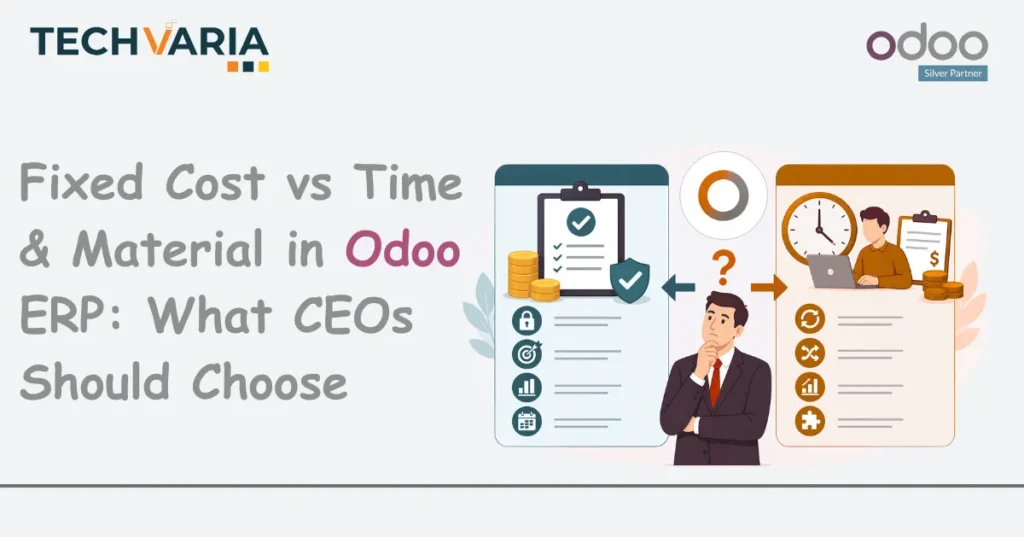
As a CEO or Founder who needs to evaluate Odoo ERP for their processes, you will come to realise that a lot depends on your choices. In this case, what you opt for fixed scope, fixed cost, or time and material.
Your choice is crucial, as Odoo’s implementation methodology guide shows that 50% of proprietary ERP projects fail. More often than not, these failures arise due to integration issues, scope creep, inflexibility and poor planning.
However, with Odoo, businesses have found experienced, successful Odoo implementations, which are largely shaped by expert insight and choice of methodology.
Odoo delivers maximum ROI when businesses learn by using it, Odoo partners adapt with them, and Odoo implementation methodology supports reality, not theory. The platform’s 95% success rate proves that the right methodology matters more than the biggest budget.
How Much Does Odoo Implementation Actually Cost?
Did you know the cost of Odoo implementation is at least 65% lower over five years compared to SAP, Oracle, or Microsoft Dynamics?
This makes the ERP platform quite popular among growing and practical businesses.
Odoo implementation cost varies for businesses due to several factors and expectations. That’s why we recommend consulting Odoo experts and discussing the scope before assuming cost.
Typically, company size and process complexity influence the Odoo ERP implementation cost, along with other components such as software licensing, implementation services, hosting infrastructure and post-live and ongoing support. Notably, the payment model is also a crucial factor in this case, as they influence overall implementation cost.
Odoo publishes fixed-price Success Packs for companies with fewer than 50 users, which often covers basic setup, advanced implementations and up to 200 hours of consultant time. In most cases, this means small businesses can scope and cost their project before committing to a plan, while mid-sized enterprises working with certified Odoo partners will find that the overall cost varies based on complexity and customisation requirements. For large organisations running multi-site deployments, Odoo offers direct consultation to understand and plan the project.
The Two Ways to Run an Odoo Project
Fixed Scope, Fixed Cost
In this model, businesses agree upfront on the basics that define the project’s trajectory. They discuss their expectation, project delivery timeline, scope and cost right at the beginning. This helps both parties understand expectations and limitations from the beginning and plan the project accordingly. Because of this, the fixed scope and fixed cost model is considered safer in most cases. The fixed cost approach also appears cheaper initially, however change requests and delays could inflate the final spend.
Time and Material, or Building in Phases
In this model, businesses often focus on their priorities and start with them. They prefer building in phases as the businesses learn and adapt and then increase scope over time. For this incremental model, businesses pay for the effort that goes into bringing expectations to life. However, many consider this incremental model risky as it needs active governance, but it is actually smarter if you know how to utilise it for your benefit.
Three Odoo Projects That Show the Difference
Example 1: When Fixed Scope Worked
Industry: Local Trading
Company Size: 25 users
Modules: Sales, Purchase, Inventory and Accounting
Customisations: Minimal
What happened: The trading company’s business processes were already standardized, but they wanted to replace their legacy accounting software without the need for complex approval or integrations.
Implementation approach: They opted for the fixed scope and fixed cost approach and wanted the project to be completed within a 3-month timeline.
Outcome: The project was delivered on time and completed within the given budget. The simple design enabled the users to adopt it quickly.
Verdict: The company was pleased with the Fixed Scope, which explains that when a business is stable, the fixed scope fixed cost model works.
Example 2: When Fixed Scope Went Wrong
Industry: Manufacturing and Distribution
Company Size: 120 users
Modules: Manufacturing, Inventory, Quality and Accounting
Customisations: Medium to High
What went wrong: During workshops, the company’s requirements looked clear. However, the actual problems surfaced during UAT, including complex routing, production constraints, reporting gaps and process complications. Soon, every improvement became a Change Request.
Business impact: The final cost exceeded the original estimate and the company’s budget. The project’s Go-live was delayed by months and eventually, the relationship became contractual, not collaborative.
Verdict: Fixed Scope blocked their business learning and ERP revealed realities they didn’t know initially.
Example 3: When Time and Material Delivered Better Results
Industry: E-commerce and Retail Size: Rapidly scaling from 40 to over 110 users Modules: Sales, Inventory, Website, POS and Accounting Integrations: Logistics and payment gateways
Implementation approach: Phase 1 focused on core operations, live fast, while Phase 2 optimised warehouse operations and Phase 3 delivered automation and dashboards.
What worked: The CEO focused on features every two weeks and dropped low-value ideas right away. The team also tracked the budget each month.
Outcome: The company achieved faster go-live and better user adoption. The ERP evolved with the company’s business growth.
Verdict: The Time and Material approach matched their business speed and objectives.
Why CEOs Get Stuck on Fixed Costs
Some CEOs believe that ERP is plug-and-play. However, it is far from practice.
Odoo is flexible by design, which allows companies to understand inefficiencies in existing processes and tweak them according to expectations. But, in the absence of such flexibility, companies may never find out or fill the gaps.
Two Beliefs That Confuse the CEOs
Many CEOs believe that Fixed Cost means lower risk. In reality, risks never disappear and are often masked as change requests, delays, complex approvals and compromised solutions.
Similarly, some believe that the Time and Material approach means businesses have no control. However, many don’t realise that trusted Odoo implementation partners provide weekly progress visibility, phase budgets, discuss permissions and clear stop/go decisions beforehand. In cases of lack of control, it is often poor governance, not the Time and Material approach, that is to be blamed.
Cost Factors CEOs Tend to Miss
These factors tend to impact Odoo implementation services costs but are often overlooked by CEOs:
Customisation complexity: When a company wants customisation, each module can add to the development, testing, documentation, upgrade and maintenance cost that multiplies over the year. Every custom module adds development, testing, documentation, and crucially, upgrade maintenance costs that multiply over the years. We recommend our clients minimise custom Odoo development to favour configuration wherever possible, as medium to high customisations can inflate implementation costs by nearly 40–60%.
Data migration quality: Businesses must dedicate ample time for data cleaning, mapping, reconciliation and mock migration. This is crucial because bad data can jeopardise go-live and performance thereafter. Many Odoo implementation companies can vouch that data quality issues are more common causes for delays than technical challenges.
Integration requirements: Connecting Odoo ERP to e-commerce platforms, analytics tools, payment gateways, and warehouse management systems requires additional development, increasing both complexity and cost.
Training and change management: Proper training is indispensable for smooth adoption. The most successful projects are those that have set aside at least 10-15% of their budget for full user training and change management processes.
Post-implementation support: Many businesses underestimate ongoing costs and underplay bug fixes, performance tuning, enhancements, and upgrades. Odoo certified partners can offer a better estimate and monthly support packages depending on the scope. In case of doubt, they will explain why Odoo support and maintenance matter after go-live so that you can make an informed decision.
Why Most Mid-Market Businesses Should Go Hybrid
This is how smart Odoo projects are run:
Phase 1- Core Setup: Fixed Scope, Fixed Cost
The first phase usually covers basic inventory, accounting, documentation and compliance and follows standards across industries. From the beginning, both parties are clear about the requirements and deliverables, which ensures the scope is predictable. This kind of model works when teams need little discovery about their ongoing processes.
Timeline: 6 to 12 weeks Investment: £8,000–£15,000 for an SME
Phase 2- Growth and Improvement: Time and Material
The second phase includes automation, custom reports, third-party integrations and process improvements. Businesses adopt changes as they learn more about their operations and processes. The Time and Material model allows Odoo development companies to adjust solutions and implement them incrementally as they gain clarity over requirements.
Timeline: Ongoing, in 2 to 6-month phases
Investment: £2,000 to £8,000 per phase
Why This Combination Works
The hybrid approach offers a predictable outcome in the first phase, which in turn gives both parties flexibility as the teams learn to adapt. In this phase, companies also learn to build a transparent relationship with an Odoo partner and understand each other’s working style better.
How to Choose the Right Model for Your Business
Before anything, you should ask yourself these crucial questions:
- Are your processes fully standard?
- Are you confident that nothing, including your workflow processes, would change in 6 months?
- Do you want to implement ERP or transform daily operations?
Businesses that want to transform are often better with an incremental Time & Material model.
Pick a model that will suit your business operations and flow. For instance, if your processes are standardized and stable, the Fixed Cost model can offer predictability. If you are transforming daily operations or wish to scale them rapidly, the Time and Material model offers the required agility. Meanwhile, most mid-market businesses will benefit from going hybrid and accessing the best of both models.
Besides your choice of model, the expertise of an Odoo consultant is quite crucial.
That’s why it is recommended to choose Odoo certified partners who have a proven track record and carry relevant industry experience. To ensure their methodology matches with your business, it is crucial to ask about their success rate, case types, average implementation timeline and approach to scope change.
These are non-negotiable to ensure your Odoo ERP implementations do not succumb to software limitations or lack of coordination.
Work With Techvaria
At Techvaria, our team of professional Odoo experts is trained to handle various situations with ease.
We are an Odoo Silver Partner, which means you can expect the best Odoo implementation services from us and build ERP solutions or custom Odoo development capabilities that deliver the best results.
Our experienced Odoo consultants and Odoo developers understand the suitability of both Fixed Cost and Time and Material models and can help you select the best Odoo implementation methodology based on your business needs.
Talk to our Odoo developers to understand why your business needs tailored support and not generic templates. Request a complete Odoo implementation checklist for SME to plan everything better.
Contact the Techvaria team to book a free consultation or to find out the Odoo implementation cost.
To hire an Odoo developer, email us at info@techvaria.com and work with an expert who will build an Odoo ERP implementation that works for your business.

Mustufa Rahi is an Odoo Certified Functional Consultant and ERP expert at Techvaria with 15+ years of experience in implementation, automation, and business process optimization, helping organizations scale efficiently.