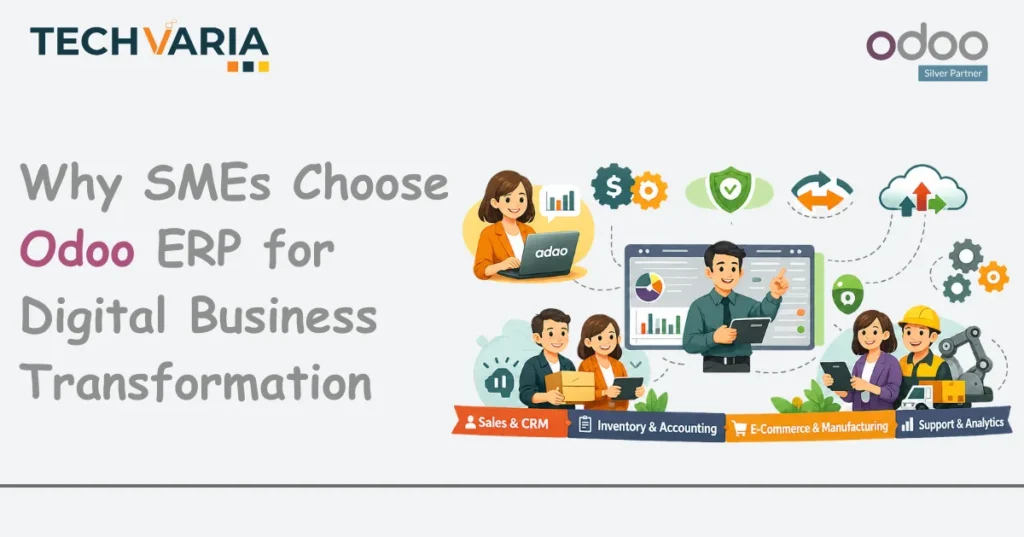
Many small and medium-sized businesses are planning to digitize their operations to keep pace with changing trends. As they learn to adapt to shifting trends, they are seeking practical solutions like Odoo ERP for SMEs to ease into the process.
Today, over 16 million users across 170,000 companies run their operations on Odoo and its customer base is growing every year. As industry experts, we understand why the ERP platform is becoming their go-to choice and we understand the reasons.
Odoo ERP for SMEs serves as a single platform connecting core business functions like sales, accounting, HR, inventory and manufacturing without bringing the complexities of traditional enterprise software. This is why SMEs that want to streamline their operations are exploring what Odoo ERP can offer to support their business transformation goals.
Why SMEs and MSMEs Need Digital Transformation
Even in 2026 many SMEs depend on disconnected tools. They use spreadsheets to record inventory, manual purchase orders, chase deliveries on call and even create a separate account for packages, which in turn, creates several problems like –
- Manual processes, which slow down everything and increase the risk of duplicate data entry and waste hours on tasks that can be automated.
- Isolated databases limit departments from sharing accurate information. Often, the finance department uses data from the warehouse, making them dependent on the final update and delaying decision-making.
- Scalability struggles when a business grows; it struggles to manage manual processes without a bigger staff or challenges in the underlying system.
In such cases, a planned digital transformation through Odoo ERP implementation can solve the issues and help scale growth.
Why SMEs Are Turning to Cloud-Based ERP
We have seen how traditional ERP systems can prevent SMEs from meeting their true potential for years. Many on-premise deployments of traditional systems require expensive service and an in-house IT team, and implementations can often extend 12 to 24 months, straining SMEs’ budget and timeline pressure.
However, when they switch to cloud-based ERP, these issues cease to exist thanks to the features that come along, like –
- Zero hardware cost – there’s no need to buy or replace servers
- Faster deployment – for a team of 10–25 users, Odoo implementations can be completed within 2–4 months
- Vendor-managed maintenance – ensures timely automatic updates to rid hidden IT costs
- Mobility – teams can access the full system from any device and anywhere allowing them the flexibility they seek
- Enterprise-level security – allows SMEs to access cloud infrastructure they could not replicate independently
Today, large enterprises hold nearly 62% of the global ERP market revenue but SMEs are the faster-growing adopter due to affordable cloud-based ERP solutions.
What Is Odoo ERP? The Complete SME Solution
Odoo ERP is an open-source and integrated business application suite. The ERP covers more than 100 modules, including CRM, accounting, inventory, HR, ecommerce and project management which share a single unified database.
In addition, these aspects of the ERP make it suitable for SMEs and MSMEs –
- Odoo’s community edition is free and includes core business functions
- Its Enterprise edition operates on a per-user subscription model which includes access to all modules
- For smaller teams, SME implementation costs under USD 10,000 compared to six-figure deployments for traditional ERP systems
Core Odoo ERP Features for SMEs
- Sales and CRM Management to track customer leads, manage request pipelines, automate follow-ups and convert quotes into orders in a flow. It lets sales teams access the full history of customers without using multiple tools.
- Accounting and Finance automates invoicing, supports multi-currency support, facilitates bank reconciliation and allows real-time financial reporting. This feature helps replace manual bookkeeping and saves both time and effort, especially during the busy season.
- Inventory and Warehouse Management allows real-time stock tracking, automated replenishment, demand forecasting and multi-location warehouse management to prevent stockouts and reduce carrying costs. This allows SMEs to stay prepared during peak seasons.
- Purchase and Vendor Management centralizes supplier records, automates purchase orders, follows up on shipments and tracks delivery status. It offers businesses traceability about product movement from purchase to payment.
- HR and Payroll helps manage employee records, leave approvals, appraisals, recruitment pipelines and payroll processing from a single dashboard.
- Manufacturing and MRP can plan production runs, manage bills of materials, track work orders and monitor shop floor activity all in real time. It helps SMEs in manufacturing reduce their production lead times.
- Project Management allows SMEs to assign tasks, track time, manage deadlines and bill clients from completed project work.
- Reporting and Business Intelligence supported by live dashboards, pre-built reports, deal history and Odoo Spreadsheet (BI) allow businesses to access accurate data without waiting for end-of-month reports.
How Odoo Transforms SME Business Processes
Odoo ERP transforms business processes for SMEs in these ways –
- Automates processes by removing manual steps
- Offers real-time data and insights into invoice status and sales performance
- Promotes collaboration across different teams to reach a common goal
- Centralises core business operations to maintain one dataset and one record system
Odoo Community vs Enterprise: What Should SMEs Choose?
| Category | Community | Enterprise |
|---|---|---|
| Cost | Free | Per-user subscription-based |
| Hosting | Self-managed | Cloud (Odoo.sh) or on-premise |
| Modules | Core business modules | Full suite that includes advanced features |
| Support | Community forums | Official Odoo support |
| Best for | Tech teams with tight budgets | Growing SMEs that seek full features and support |
SMEs with more than 10 users and managing several departments could find Odoo Enterprise to be a better solution for the long-term. Its upfront subscription cost gets offset through reduced manual work and external support.
Real-World Use Cases
A coffee operator that works across multiple countries is a specialty brand and roasts and packs its coffee and has a multi-stage production. To ensure better coordination across its eight warehouses, it implemented a customised Odoo ERP. The brand’s goal was to assign specific roles to its warehouses alongside tasks like procurement, cleaning, roasting, grinding, blending, quality control and dispatch.
The ERP system helped automate the processes, set reordering rules, streamlined inter-warehouse transfers and enabled batch traceability through QR codes. It also helped add custom quality checkpoints to maintain roast level, consistency, aroma and texture. Over time, the brand’s production increased by 50% and reduced stock-outs. In addition, it achieved traceability across production stages, which helped manage supply chains and operations much better.
Implementation Success Factors
A modern ERP will not guarantee you success unless you have the right kind of support and an Odoo implementation partner to work with during this phase. Certified Odoo partners understand business needs and industry concerns and offer suitable solutions. However, to ensure your collaboration with the professionals works out for the best, weigh in these critical success factors –
- Define your scope clearly, early, before any configuration begins
- Involve the actual end users so that they can identify the gaps that management often misses
- Plan a phased rollout and start with the core modules to gain confidence as the team expands
- Invest in training, support and maintenance before you go-live
Businesses also need to be mindful of these common pitfalls that can hamper their Odoo experience –
- Over-customising before testing standard features
- Not planning data migration or paying attention to data quality
- Skipping the user acceptance testing (UAT) phase
With TechVaria you don’t have to worry about these pitfalls or missing out on the key elements from the Odoo implementation checklist for SMEs.
As an Odoo Silver partner, we are a trusted name in the industry that is known for our quality of projects and expertise. As professionals, we follow a structured implementation methodology that goes beyond discovery and configuration, and focuses on data migration, training, support after go-live and maintenance.
How to Successfully Implement Odoo ERP for SMEs
As certified Odoo experts, we recommend following these to ensure successful implementation:
Planning and Requirement Analysis
SMEs must map their existing processes and note down the areas that cause them the most pain. Next, they must define their scope of modules and requirements but ensure they set realistic go-live milestones and measurable outcomes to understand performance. These steps should be carried out before any technical work begins.
Implementation and Customisation
Businesses should aim for covering at least 80% of their requirements through standard Odoo configuration. We recommend developing targeted customisations only for processes where standard Odoo falls short.
User Training and Go-Live
If businesses want smooth adoption and better results, they need to invest in training teams. As end users they must participate and understand the ERP to make the most of the modules and integrations. SMEs should ease them into the process by running parallel operations before going live while working on rollback plans.
Why Work With an Odoo Implementation Partner
The answer is quite simple – any configuration decisions made without proper ERP experience or technical expertise can create problems that arise weeks or months after the go-live phase.
A certified Odoo implementation partner like Techvaria brings the required knowledge of which modules fit which business models. In addition, they know how to structure data and where most SMEs go wrong. These experiences along with the headaches they prevent make it worth working with a professional.
By working with us you can expect to receive a tailored implementation methodology and solutions that fit your business and your budget. We have clients in India, the UAE and Europe who have benefited from our expertise in live implementations across industries.
Check out our Odoo ERP services to understand our scope and offering.
Conclusion
Odoo ERP for SMEs is a smart choice as it helps tackle concerns like high cost, long timelines, complex methodologies and rigid systems that deter the growth of small businesses. Odoo ERP’s modular design, transparent pricing, structured modules and vast partner network make it a capable choice for SMEs looking to transform their digital presence.
Businesses, especially those that still function on disconnected tools or overtly manual processes, can amp up their processes and prevent lags by switching to the right kind of Odoo ERP. Additionally, to make your transition smooth, work with the best professionals in the business. Certified Odoo experts will assess your current processes, recommend the right Odoo modules, plan rollouts and deliver a structured implementation to suit your budget and requirements.
If you, too, are ready to start your Odoo ERP implementation, Contact Techvaria team today!
Contact us at info@techvaria.com to discuss the next step.
Hurry! To start your business transformation today!

Mustufa Rahi is an Odoo Certified Functional Consultant and ERP expert at Techvaria with 15+ years of experience in implementation, automation, and business process optimization, helping organizations scale efficiently.